

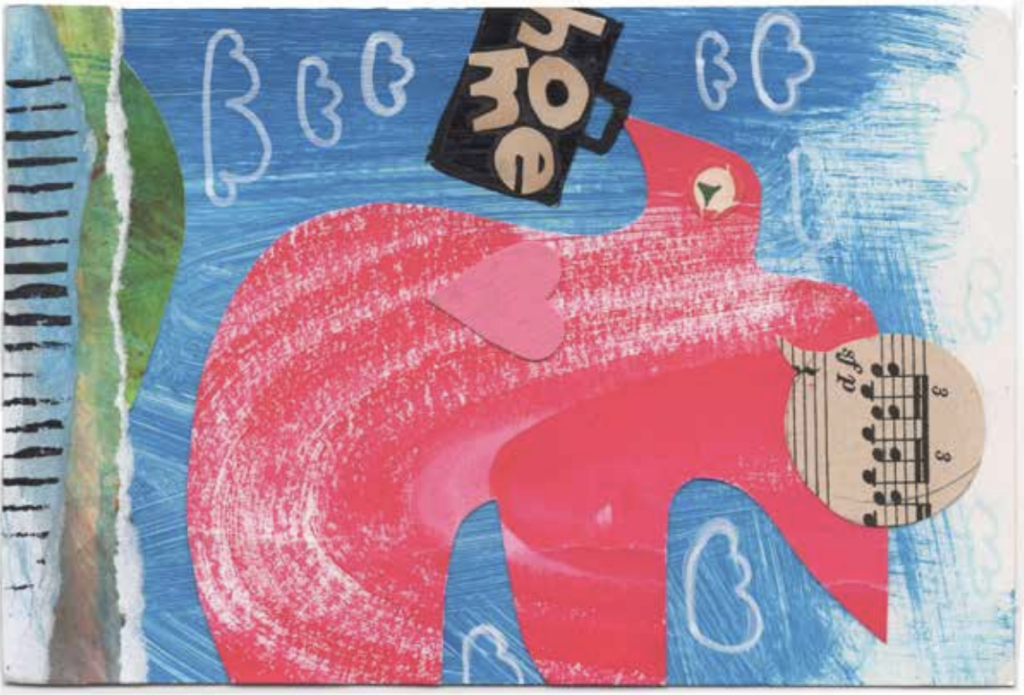
Attunement in Multilingual Arts-Based Refugee Education (AMARE): a Practice-as-Research project aiming to explore attunement in performative language education.
Attunement refers to the ability to become present and receptive. Language attunement implies recognising and responding to the verbal and non-verbal elements of one’s heritage language, the host language and additional languages spoken in a multilingual environment. It is grounded in presence, awareness, and receptivity as essential elements of language learning.
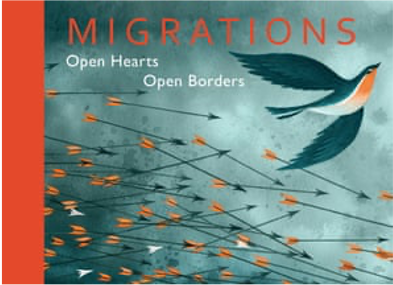
As with our previous project, Sorgente, our practice is inspired by imagery from the art collection Migrations: Open Hearts, Open Borders, curated by Tobias Hickey, founder of the founder of the International Centre for the Picture Book in Society, University of Worcester, UK.
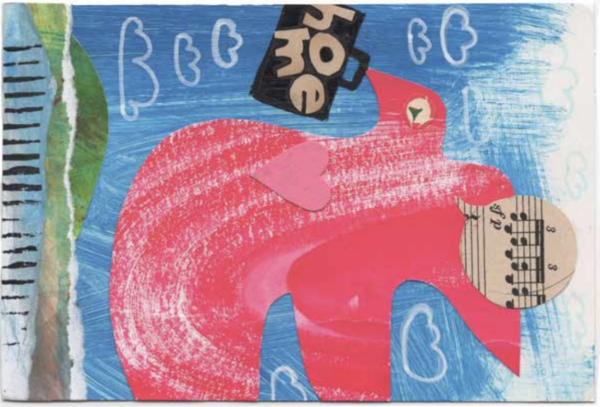
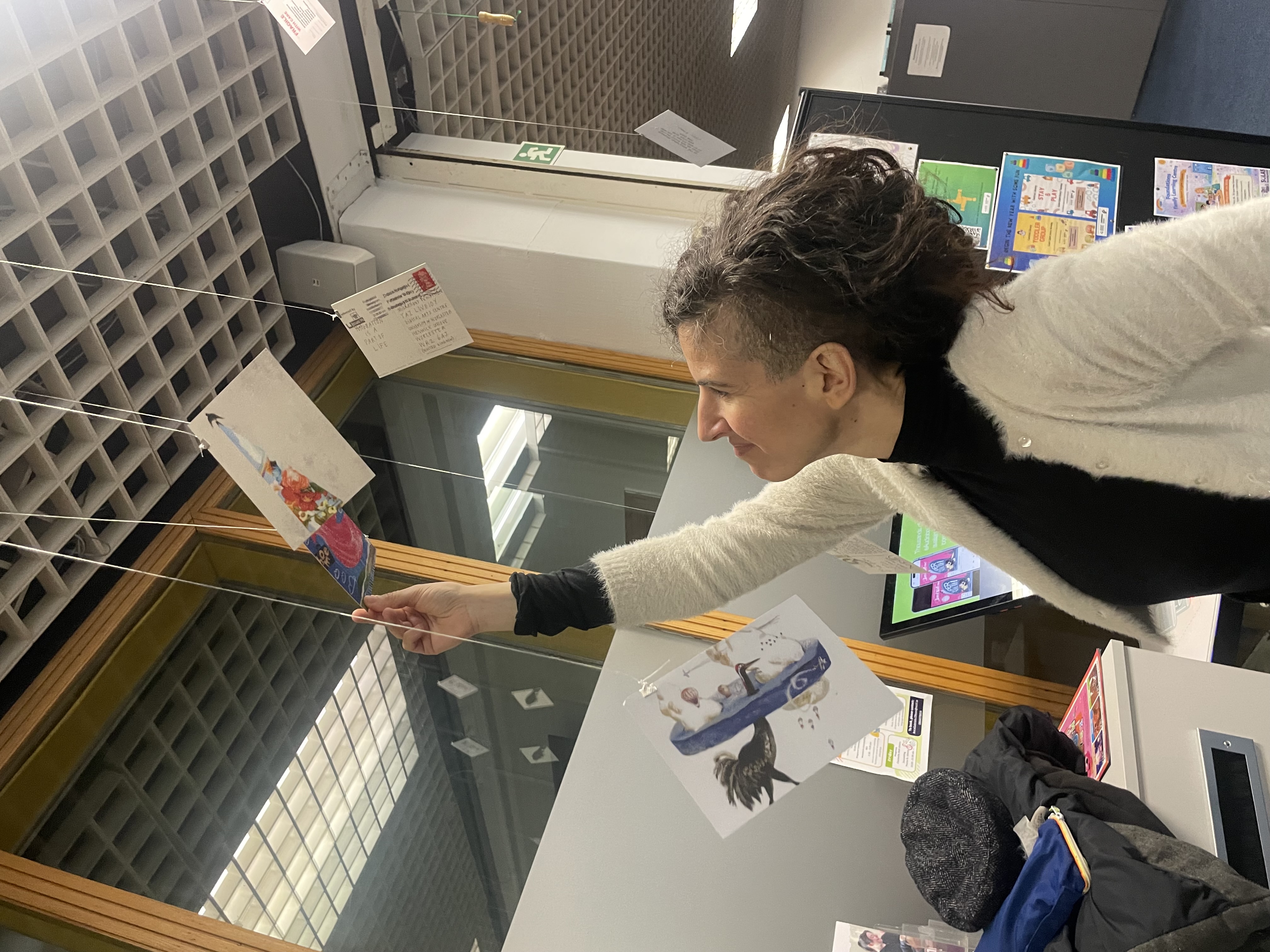
Featuring over 100 postcard-sized artworks by more than 50 illustrators from 28 countries, Migrations explores human migration through the poetic metaphor of birds in flight. Each work offers a personal and imaginative response to themes of movement, belonging, and hope.
An evolving and itinerant project, Migrations has been exhibited internationally in Bratislava, Seoul, Cape Town, Munich, and London. The collection will be showcased in Dublin at the Central Library, ILAC Centre between January 21 and February 09, 2026.
The Dublin exhibition is supported by the Faculty of Arts, Humanities and Social Sciences (FAHSS) Benefactions Fund, Trinity College Dublin, the University of Dublin.
Visual Arts.
Creative Writing.
Improv.
Voice work.
Drama.
Music composition.
Dance.
These are some of the arts forms we drew on to engage our participants in language learning, taking a performative approach to language education.
The AMARE project aims to explore the construct of attunement within the context of performative language education. Attunement as a broad construct will be examined across various domains. These include attunement with language (Lutzker, 2014), attunement through the body (Aoki, 2005; Nagamoto, 1992; Markman, 2020; Jaramillo et al., 2019), relational and somatic attunement (Murphy, 2024), and attunement in sound-based music education. Together, these perspectives contribute to a rich, multidimensional understanding of attunement.
The research questions guiding this inquiry are:
- What is the relationship between ‘attunement’ and language learning, in an arts-based context?
- How might ‘attunement’ form the basis of teacher collaboration across disciplines in migrant education?
- In what ways might ‘attunement’ emerge through learners’ performative engagement with the Migrations postcard collection?
AMARE is informed by a qualitative orientation to research, informed by Practice-as-Research and arts-based research (Leavy, 2025).
Research methods will include arts practice (documented through sketches, audio recordings, photographs of artefacts), peer observations, interviews and stimulated recall. The data will be analysed through reflexive Thematic Analysis (Braun & Clarke, 2019), using creative analysis methods (Kara, 2020) and inductive coding to generate themes.
The project is organised as two case studies. The first will be conducted in Dublin (Ireland) led by Erika Piazzoli, School of Education, Trinity College Dublin, and in collaboration with Youthreach (City of Dublin Education and Training Board). The second case study will be conducted in Padova (Italy) with Razzismo STOP, led by Fiona Dalziel from the University of Padova.
The AMARE fieldwork is structured as a a series of performative language workshops (20 hours in total) facilitated by four staff and one research assistant, (Case Study 1) and 8 workshops, for a total of 16 hours, facilitated by two staff (Case Study 2) between February and April 2026.
AMARE’s international partner is Prof. Fiona Dalziel, at the University of Padova. Prof. Dalziel has conducted performative language work for over 25 years.
Prof. Dalziel is working on a case study featuring a series of drama-based workshops with refugees and migrants through the Razzismo Stop NGO in Padova. Our aim is to cross-reference our experiences as facilitators to investigate AMARE’s research questions.
The project builds on our previous collaboration, Sorgente project findings, known as Painting the Shades Between Safety and Bravery, encompassing a set of recommendations for trauma-informed performative pedagogy (Piazzoli et al., 2023; Piazzoli & Dalziel, 2024). The AMARE project will apply the Sorgente framework to a new iteration of practice, working with teachers, as well as the students, from Youthreach and Razzismo Stop.
Balfour, M., Bundy, P., Burton, B., Dunn, J. & Woodrow, N. (2015). Applied theatre: Resettlement: Drama, Refugees and Resilience. London: Bloomsbury Publishing.
Dalziel, F. & Piazzoli, E. (2019). ‘It comes from you’: Agency in adult asylum seekers’ language learning through Process Drama. Language Learning in Higher Education. 9 (1).
Finley, S. (2020). Arts-based research. In: G.J. Knowles & A. L. Cole. (2020). Handbook of the Arts in Qualitative Research. SAGE Publications Limited.
Hanks, J. (2019). From research-as-practice to exploratory practice-as-research in language teaching and beyond. Language Teaching, 52(2), 143-187.
Hanks, J. (2017). Exploratory practice in language teaching: Puzzling about principles and practices. London: Palgrave MacMillan/Springer.
Hanks, J. (2015). Language Teachers Making Sense of Exploratory Practice. Language teaching research. 19 (5), 612–633.
Jeffers, A. (2008). Dirty truth: Personal narrative, victimhood and participatory theatre work with people seeking asylum. Research in Drama Education: The Journal of Applied Theatre and Performance. 13(2), 217–221.
Youthreach, North Great Georges Street, a further education programme for early school-leavers in Dublin, Ireland;
Razzismo Stop in Padova, Italy.
The Dublin exhibition at the Central Library, ILAC Centre, is supported by the Faculty of Arts, Humanities and Social Sciences (FAHSS) Benefactions Fund, Trinity College Dublin, the University of Dublin.
RESEARCH TEAM
- Erika Piazzoli, Associate Professor, Arts Education, School of Education & Director of the Arts in Education Research Group (AERG), TCD;
- Fiona Dalziel, Associate Professor, Department of Linguistics and Literary Studies, University of Padova & AERG Visiting Fellow, School of Education, TCD;
- Edmond Gubbins, Teaching Fellow in Music Education, The University of Limerick & AERG Visiting Fellow, School of Education, TCD;
- Garret Scally, AERG Visiting Fellow, School of Education, TCD;
- Kathleen Warner Yeates, Director, Flying Turtle Productions & AERG Visiting Fellow, School of Education, TCD;
- Miriam Stewart, Europass Teacher & AERG Visiting Fellow, School of Education, TCD;
- Rachael Jacobs, Associate Professor in Creative Arts Education, Western Sydney University & AERG Visiting Fellow, School of Education, TCD;
- Eileen Keane Niland, Lecturer in Visual Arts, Marino Institute of Education & AERG Visiting Fellow, School of Education, TCD;
- Ana Janelidze, PhD candidate & picturebook illustrator, School of Education, TCD.
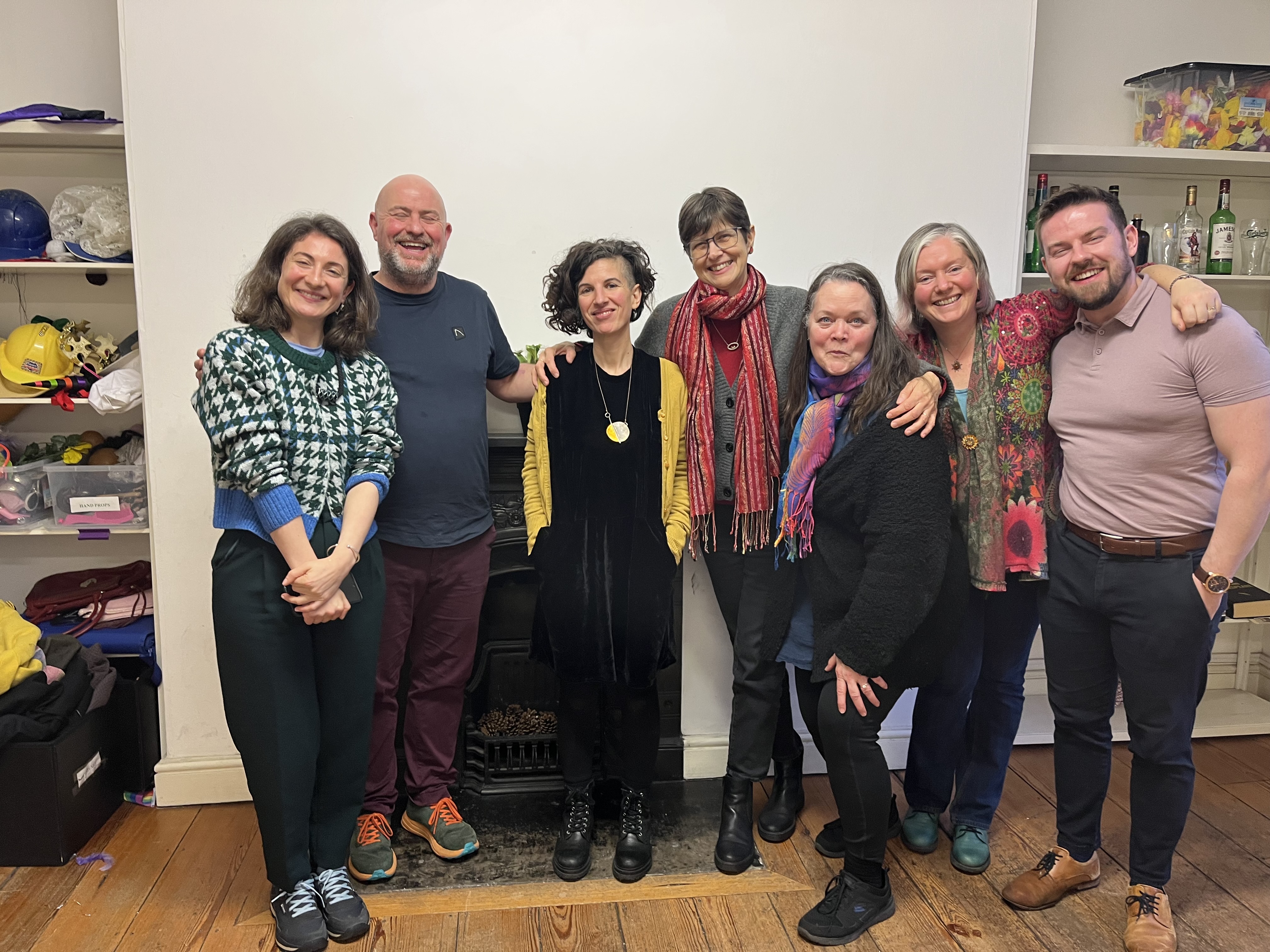
L-R: Ana Janelize, Garret Scally, Erika Piazzoli, Fiona Dalziel, Kathleen Warner Yeates, Miriam Stewart, Edmond Gubbins.
Image Credits: Migrations. Artwork by Helena Bergendahl, ‘Migrations. Open Hearts, Open Borders’